
This website has affiliate links to products. If purchases are made through these links, we may receive a commission. These affiliate links help pay for the costs of hosting this website, and we are grateful for your support.
Have you ever wondered why fairy tales remain timeless—why stories we heard as children continue to echo in us long after we’ve grown? These myths endure because they speak the symbolic language of the soul.
Fairy tales carry spiritual truths about identity, loss, and return, waiting for us to be ready to understand them. This article begins the GratefulEmpath Series on Spiritual Wisdom Hidden in Fairy Tales, starting with Rapunzel (Tangled for Disney) as a mirror for inner child healing and spiritual awakening.
Rapunzel: Inner Child and Original Song
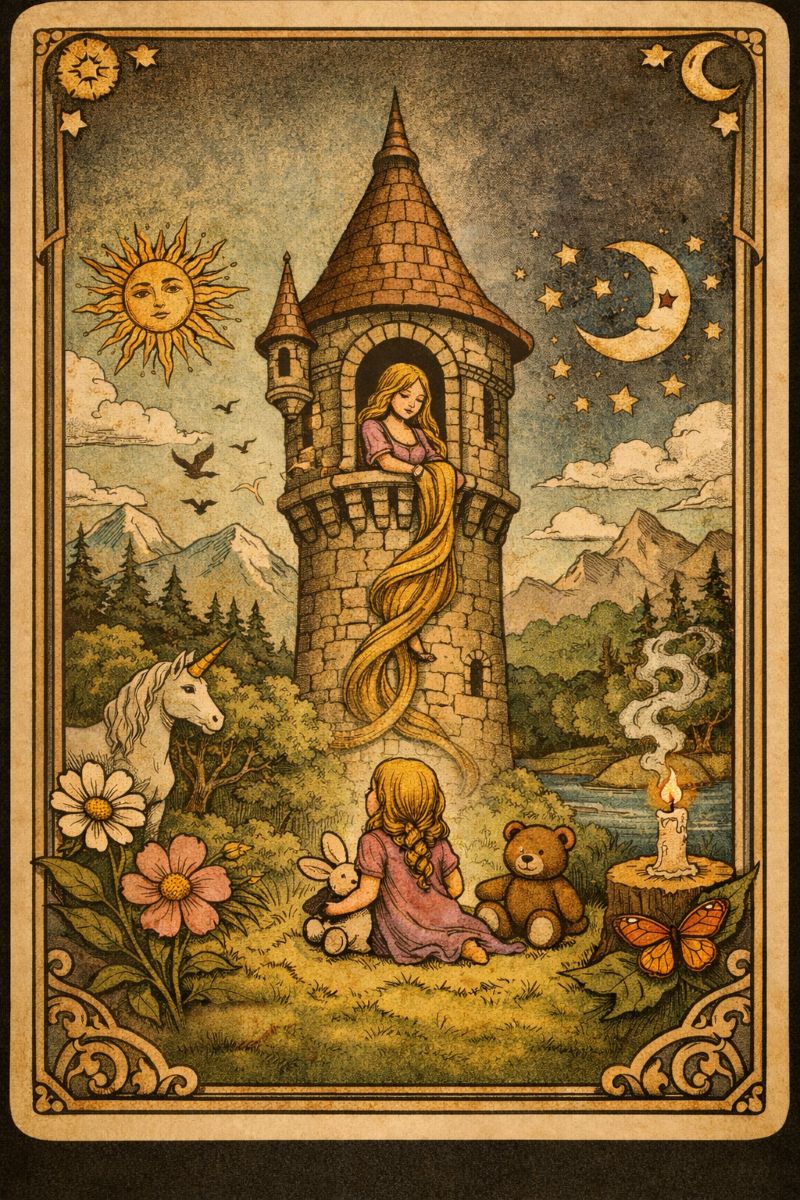
Rapunzel represents the inner child—the pure, unconditioned self that existed before fear, programming, or survival strategies took hold. The part of us that carries the original song of the Universe, the voice that remembers our connection between heaven and earth. Even if silenced or hidden away, this voice is never lost.
Rapunzel embodies both innocence and wisdom, reminding us that the inner child is not naïve, but deeply intuitive. Her longing to see the world reflects the soul’s natural desire to express, create, and belong.
The Tower: Protective Wound
The tower symbolizes the protective structure we build around the inner child after experiencing pain, fear, or loss. It is based in a belief that isolation equals safety; the tower represents emotional walls, coping mechanisms, and identities formed to avoid being hurt again.
While the tower keeps danger out, it also keeps life out. Over time, protection hardens into confinement, and safety becomes a prison. The tower asks us to question whether what once saved us is now limiting us.
Mother Gothel (Old Woman): Ego as Gatekeeper
The old woman represents the ego—the part of us that believes control is safety. She is the inner critic, the gatekeeper that insists the world is dangerous and that authenticity must be managed or hidden. Her love is conditional, rooted in fear rather than trust.
This aspect of the psyche does not see itself as cruel; it believes it is protecting us. Yet by locking Rapunzel (inner child) away, the ego prioritizes control over growth. It fears what might happen if the true self is released.
The Prince: Adult Self Who Remembers
The prince represents the mature adult self (not a rescuer), the part of us that remembers who we truly are. He does not save Rapunzel from herself; he journeys toward her with courage and devotion. He is the bridge between the inner child and the outer world.
This aspect of the self climbs the tower willingly, facing fear rather than avoiding it. The prince symbolizes integration: the adult capacity to protect, choose, and embody the soul’s truth. Healing happens not when the child escapes alone, but when the adult returns to meet her.
The Braid: Memory, Voice, and Feminine Power
Rapunzel’s hair represents connection between past and present, body and soul, memory and expression. It carries lineage, wisdom, and the feminine power of voice and creativity. The braid is both ladder and lifeline.
Importantly, it is the only way in and out of the tower. Healing requires reconnection to memory, not disconnection from it. The braid reminds us that our voice, once reclaimed, becomes the pathway to freedom.
The Parents: Call Home
Rapunzel’s parents symbolize the part of us that has always been waiting for our return. They represent the original wound of separation (the moment we forgot who we were) and the longing for reunion with the true self. Their love never disappears, even when we do.
This reunion reminds us that abandonment was only the story we told ourselves to survive. Home is always calling. We are always expected back.
Ascension and Integration
Rapunzel’s journey teaches us that healing requires both climbing up the tower (ascension) and coming back down (integration). Awakening alone is not enough; we must also embody what we remember. True wholeness is not escape from the world, but presence within it.
The fairy tale ends not in the tower, but in life, where the inner child and adult self walk together. When we reclaim the voice, integrate the wound, and soften the ego’s grip, the soul is free to live fully expressed. This is not fantasy—it is remembrance.
Affirmation
May we remember the song that was never taken from us.
May we honor the tower that once protected us and gently choose to open its doors.
May our adult self meet our inner child with patience, courage, and love.
And may we trust that what is meant for us has always been waiting for our return.
Amen. Aho and so it is!